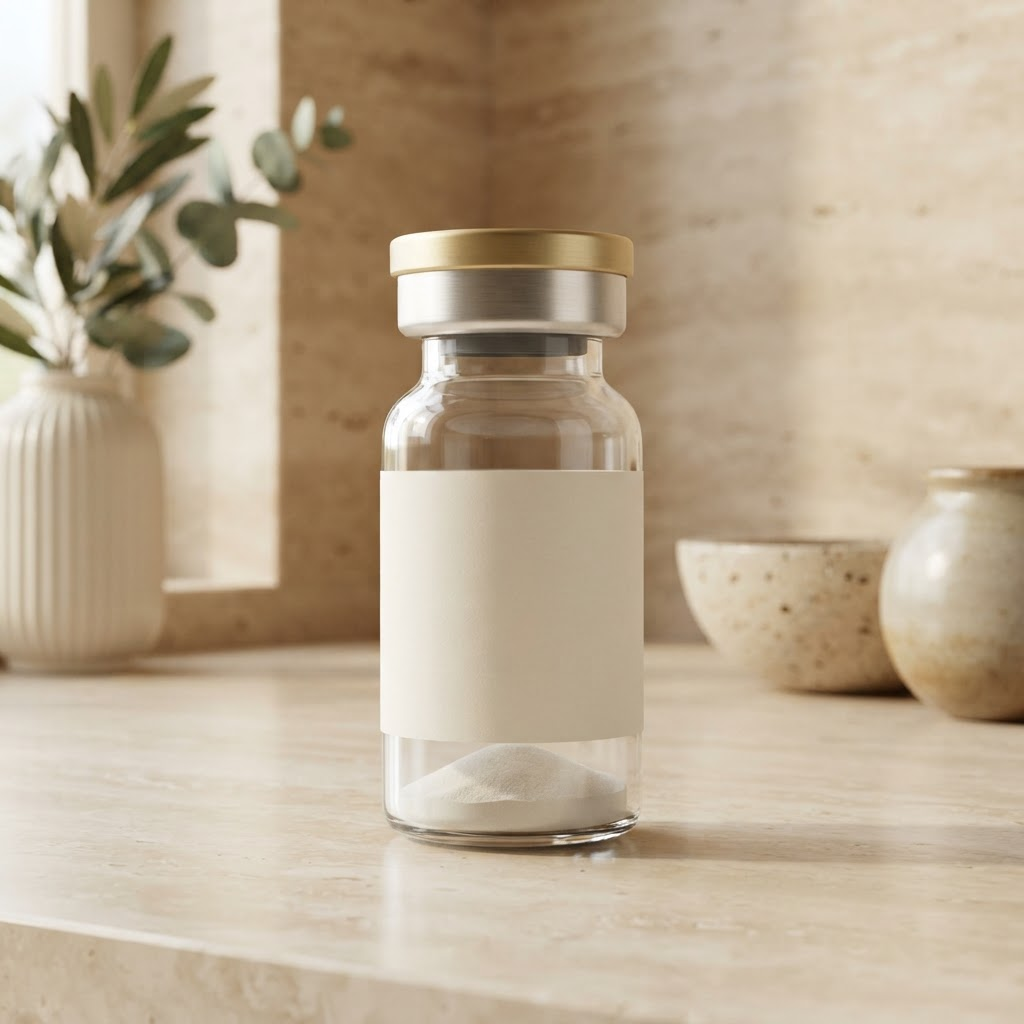
Glutathione
Antioxidant Tripeptide
- Form
- Lyophilized powder
- Storage
- -20°C (lyophilized)
- Origin
- US lab · imported API
$139
Glutathione is an endogenous tripeptide antioxidant reference material used in laboratory investigations of oxidative-stress and redox-signaling pathways.
- Oxidative-stress signaling research
- Redox-pathway models
- In-vitro cellular-redox studies
SKU: AP-GLUTATHIONE-1500MG
3 vial minimum per order — mix any products
Research Use Only
All products are intended solely for laboratory research and are not for human or animal consumption. By purchasing, the buyer agrees to use these products in compliance with all applicable laws.
Reconstitution ReferenceOptional — how strong is the mixed vial?
Mixing a powder vial with water? Fill in the fields — results update as you type.
Mixing 1,500 mg of peptide into 2 mL of water makes a 750 mg/mL solution. Each 0.1 mL contains 75 mg.
Reference for in-vitro laboratory handling only. Outputs describe the physical properties of the reconstituted vial (concentration and mass drawn) — they are not dosing guidance, administration instructions, or medical advice. Verify all measurements independently.
The science behind Glutathione
A structured overview of the published literature surrounding glutathione as an antioxidant tripeptide research compound.
Glutathione is an endogenous tripeptide (γ-glutamyl-cysteinyl-glycine) that functions as a primary intracellular antioxidant. It is studied as a reference material in redox-signaling and oxidative-stress research.
As one of the most abundant intracellular thiols, glutathione is foundational to redox-biology literature and is widely used in cellular-redox assays.
The material supplied here is a laboratory reference standard, and the summaries below describe only findings reported in published research.
Glutathione has been studied for decades as the central redox buffer of the cell, cycling between reduced (GSH) and oxidized (GSSG) forms. This chemistry underlies its role in laboratory redox research.
The literature is extensive and spans biochemistry, cell biology, and preclinical models of oxidative stress and detoxification pathways.
The core mechanism studied is thiol-based redox cycling: glutathione donates reducing equivalents to neutralize reactive oxygen species and participates in glutathione-peroxidase and -reductase reactions.
Investigators also study its role as a cofactor in detoxification (glutathione-S-transferase) pathways within cellular models.
Redox-signaling assays
Used as a reference thiol in GSH/GSSG redox-state measurements.
Oxidative-stress models
Examined in cellular models of reactive-oxygen-species handling.
Detoxification pathways
Referenced in glutathione-S-transferase and conjugation studies.
Mitochondrial redox
Studied in models of mitochondrial oxidative balance.
What is glutathione?
An endogenous antioxidant tripeptide (γ-Glu-Cys-Gly) supplied as a laboratory reference material for redox-signaling research.
What kind of research references glutathione?
Biochemistry and cell-biology studies of redox cycling, oxidative stress, and detoxification pathways.
Is Glutathione approved for human or veterinary use?
No. Glutathione is not approved by the FDA or any regulatory authority for human or animal use. It is sold exclusively for in-vitro and laboratory research and is not for consumption.
How is the reference material characterized?
Each released lot is supplied as a lyophilized powder with a lot-specific certificate of analysis reporting HPLC purity of ≥ 99%. The certificate is tied to the specific released lot.
How should the compound be stored?
Lyophilized material is typically stored at -20°C, protected from light and moisture. Handling should follow standard laboratory practice for peptide reference materials. We do not provide reconstitution, dosing, or administration guidance.
- Meister A, Anderson ME. Glutathione. Annu Rev Biochem (1983).
- Forman HJ, et al. Glutathione: overview of its protective roles. Mol Aspects Med (2009).
Links open a curated peer-reviewed search on PubMed. Allpointe Bio Research is not affiliated with the cited authors or publishers.
Research-Use Statement
The information above is provided for educational and scientific-reference purposes only and summarizes findings reported in the published preclinical and in-vitro literature. It is not medical advice and does not describe outcomes, benefits, or applications for humans or animals. Glutathione is supplied strictly as a laboratory reference material for in-vitro and research use only — it is not a drug or supplement, is not approved for human or veterinary use, and is not for consumption. Allpointe Bio Research does not provide clinical, dosing, reconstitution, or administration guidance.