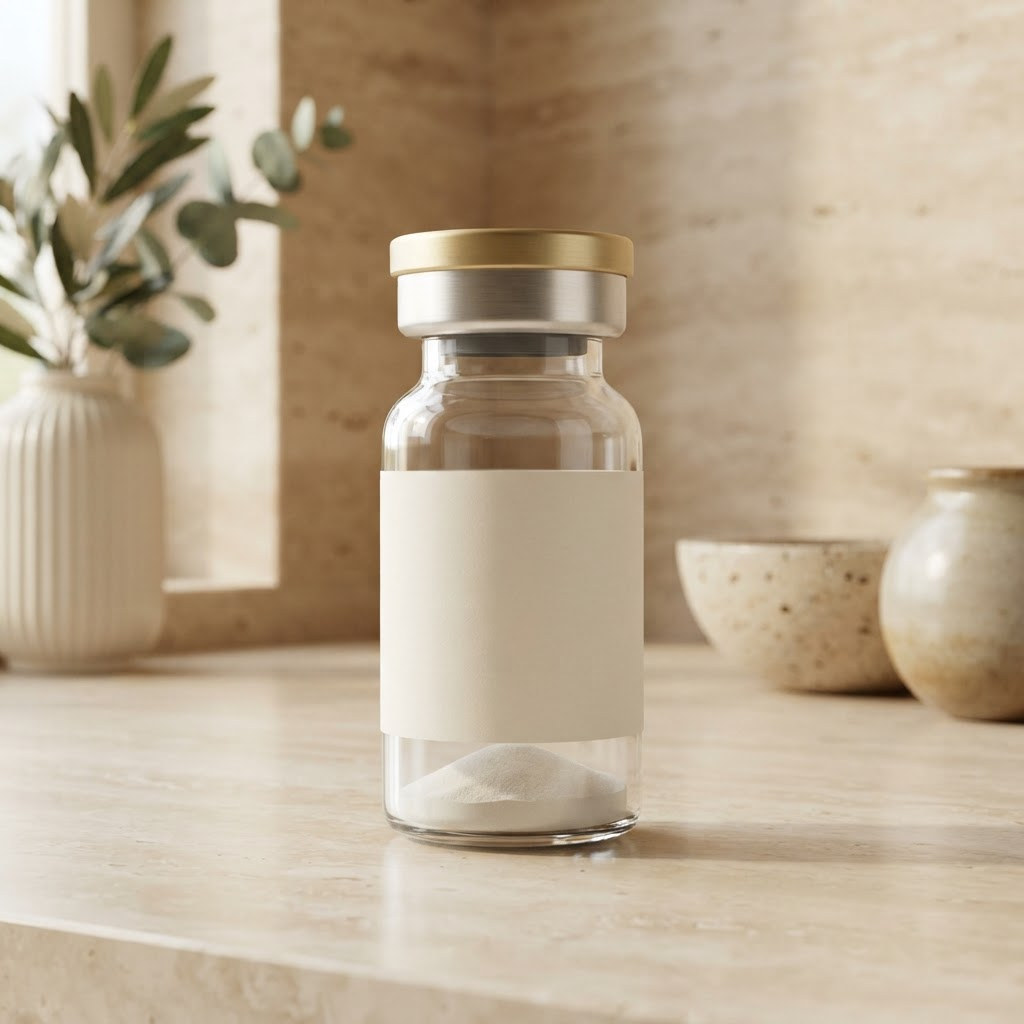
Semaglutide
GLP-1 Receptor Agonist
- Form
- Lyophilized powder
- Storage
- -20°C (lyophilized)
- Origin
- USA lab
from$89
Semaglutide is a synthetic peptide reference material used in laboratory investigations of GLP-1 receptor activity and associated intracellular signaling pathways.
- GLP-1 receptor-binding research
- Receptor-mediated cellular signaling studies
- In-vitro metabolic pathway models
SKU: AP-SEMA-10MG
3 vial minimum per order — mix any products
Research Use Only
All products are intended solely for laboratory research and are not for human or animal consumption. By purchasing, the buyer agrees to use these products in compliance with all applicable laws.
Reconstitution ReferenceOptional — how strong is the mixed vial?
Mixing a powder vial with water? Fill in the fields — results update as you type.
Mixing 10 mg of peptide into 2 mL of water makes a 5 mg/mL solution. Each 0.1 mL contains 0.5 mg.
Reference for in-vitro laboratory handling only. Outputs describe the physical properties of the reconstituted vial (concentration and mass drawn) — they are not dosing guidance, administration instructions, or medical advice. Verify all measurements independently.
The science behind Semaglutide
A structured overview of the published literature surrounding semaglutide as a GLP-1 receptor research compound.
Semaglutide is a synthetic analog of human glucagon-like peptide-1 (GLP-1), engineered with amino-acid substitutions and a fatty-acid side chain that extend its stability relative to the native hormone. In the research setting it is widely used as a reference agonist for the GLP-1 receptor.
Semaglutide is among the most-studied incretin-based compounds in the metabolic literature, appearing extensively in receptor-binding assays, cellular signaling studies, and preclinical metabolic models.
The material supplied here is intended solely as a laboratory reference standard. It is not a drug for the purposes of this listing, and the summaries below describe only what has been reported in published research.
Semaglutide was developed from research into long-acting GLP-1 receptor agonists, building on the incretin biology first characterized in the 1980s and 1990s. Its structural modifications were designed to resist enzymatic degradation and prolong circulating half-life in experimental systems.
The compound is characterized in a large body of receptor-pharmacology and preclinical metabolic literature. It is frequently used as a comparator agonist when investigators evaluate newer incretin-based research compounds.
The primary mechanism studied is agonism at the GLP-1 receptor, a class-B G-protein-coupled receptor. Binding is reported to activate adenylate cyclase and downstream cAMP-dependent signaling in cellular models.
Researchers also examine downstream effects on insulin-secretion signaling in pancreatic beta-cell models and on appetite-related neuronal circuits in preclinical systems. These are mechanistic observations within controlled laboratory settings.
Receptor-binding assays
Used as a reference agonist in GLP-1 receptor affinity and activation studies.
Incretin signaling
Examined in cellular models of cAMP signaling and insulin-secretion pathways.
Metabolic models
Referenced in preclinical models of glucose regulation and energy balance.
Neuroendocrine research
Studied in appetite- and satiety-related neuronal signaling models.
What is semaglutide?
A synthetic GLP-1 receptor agonist peptide used as a laboratory reference material for receptor-signaling and metabolic research.
What kind of research references semaglutide?
Receptor-pharmacology assays and preclinical metabolic models examining GLP-1 receptor activation and downstream signaling.
Is Semaglutide approved for human or veterinary use?
No. Semaglutide is not approved by the FDA or any regulatory authority for human or animal use. It is sold exclusively for in-vitro and laboratory research and is not for consumption.
How is the reference material characterized?
Each released lot is supplied as a lyophilized powder with a lot-specific certificate of analysis reporting HPLC purity of ≥ 99%. The certificate is tied to the specific released lot.
How should the compound be stored?
Lyophilized material is typically stored at -20°C, protected from light and moisture. Handling should follow standard laboratory practice for peptide reference materials. We do not provide reconstitution, dosing, or administration guidance.
- Knudsen LB, Lau J. The discovery and development of liraglutide and semaglutide. Front Endocrinol (2019).
- Lau J, et al. Discovery of the once-weekly GLP-1 analogue semaglutide. J Med Chem (2015).
Links open a curated peer-reviewed search on PubMed. Allpointe Bio Research is not affiliated with the cited authors or publishers.
Research-Use Statement
The information above is provided for educational and scientific-reference purposes only and summarizes findings reported in the published preclinical and in-vitro literature. It is not medical advice and does not describe outcomes, benefits, or applications for humans or animals. Semaglutide is supplied strictly as a laboratory reference material for in-vitro and research use only — it is not a drug or supplement, is not approved for human or veterinary use, and is not for consumption. Allpointe Bio Research does not provide clinical, dosing, reconstitution, or administration guidance.